Artemis Hospitals has some of the best paediatric cardiologists and cardiac surgeons in Gurugram and Delhi NCR. Our pediatric cardiologists specialise in diagnosing and treating children with complex heart conditions like congenital defects using highly precise imaging and catheterization techniques for a comprehensive analysis.
Artemis Hospital in Gurugram is a JCI and NABH accredited facility specializing in advanced pediatric cardiac care. The infrastructure includes a high-dependency Pediatric Cardiac ICU, 256-slice CT imaging, and ECMO support.
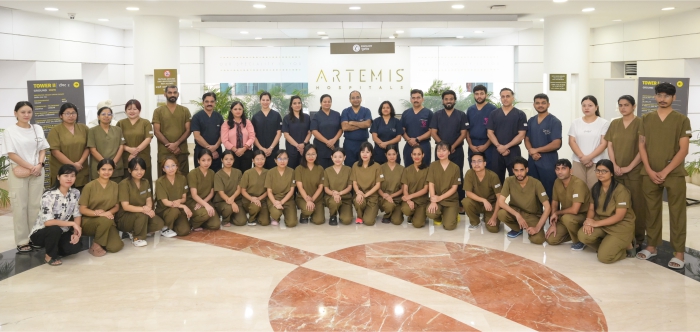
This collaborative approach between surgeons, cardiologists, and neonatologists ensures a seamless recovery process for the patient.
What is Paediatric Cardiology & Cardiac Surgery?
Paediatric cardiology and cardiac surgery deal with heart problems in babies, children, and teenagers. Some of these problems are present from birth, while others develop later.
Specialist doctors first identify what’s wrong using tests like scans and imaging. If needed, cardiac surgeons then perform procedures to repair or correct the heart’s structure.
The goal is to help the heart function properly, improve the child’s health, and support normal growth and long-term well-being.
Which Conditions are Treated at Paediatric Cardiology Department, Artemis Hospitals?
Artemis Hospitals’ Paediatric Cardiology Department treats a wide range of heart conditions in children, from common congenital defects to rare and complex structural abnormalities. These conditions affect how the heart forms, pumps, or circulates blood, and often require a combination of diagnosis, monitoring, and advanced surgical care to ensure healthy growth and long-term outcomes.
Congenital and Structural Defects
- Atrial Septal Defect (ASD): A hole between the upper chambers of the heart.
- Ventricular Septal Defect (VSD): An opening in the lower chambers affecting blood flow.
- Tetralogy of Fallot: A combination of four defects that reduce oxygen in the blood.
- Patent Ductus Arteriosus (PDA): A fetal blood vessel that fails to close after birth.
- Hypoplastic Left Heart Syndrome (HLHS): Underdevelopment of the left side of the heart.
- Aortic Regurgitation & Stenosis: Narrowing or leaking of the aortic valve.
- Mitral Valve Defects: Improper functioning of the mitral valve.
- Truncus Arteriosus: A single vessel arises instead of two separate arteries.
- Pulmonary Atresia & Stenosis: Improper formation or narrowing of the pulmonary valve.
- Total Anomalous Pulmonary Venous Return (TAPVR): Pulmonary veins connect abnormally.
- Atrioventricular Canal Defects: Large holes in the heart involving valves and chambers.
- Coarctation of the Aorta: Narrowing of the body's main artery.
- Transposition of the Great Arteries (TGA): Reversal of the two main arteries leaving the heart.
- Congenitally Corrected Transposition (CCTGA): A rare defect where the heart's lower chambers are reversed.
- Double Outlet Right Ventricle: Both great arteries connect to the right ventricle.
- Ebstein’s Anomaly: A malformed tricuspid valve that leaks blood backward.
- Tricuspid Atresia: Absence of the tricuspid valve, blocking blood flow to the lungs.
- Interruption of the Aortic Arch: A gap in the main artery supplying the body.
- ALCAPA: Anomalous origin of the left coronary artery from the pulmonary artery.
- Single Ventricle Defects: Conditions where only one chamber is functional enough to pump blood.
- Vascular Ring: Abnormal blood vessels that encircle and compress the windpipe or esophagus.
Acquired and Functional Heart Conditions
In addition to structural issues, the department manages acquired heart conditions and complex deformities requiring long-term care or critical support.
- Cardiomyopathy: Weakening or enlargement of the heart muscle.
- Kawasaki Disease: Inflammation affecting blood vessels, including coronary arteries.
- Rheumatic Fever & Rheumatic Heart Disease: Heart valve damage following untreated infections.
- Primary Pulmonary Hypertension:High blood pressure specifically in the lung arteries.
- Heart Block: Disruption in the heart’s natural electrical rhythm.
- Pediatric Heart Failure & Transplant Support: Care for end-stage cases and heart transplant needs.
- Chest Wall Deformities: Surgical treatment for conditions like Pectus Excavatum.
- ECMO Support: Life-saving support for severe heart or lung failure.
Which Advanced Diagnostic Facilities are Available at Artemis Hospitals?
Artemis Hospitals offers advanced pediatric non-invasive imaging including Fetal Echo for prenatal detection, Pediatric Echo for structural assessment, ECG for rhythm analysis, Pediatric Cardiac CT for detailed vessel imaging, and Pediatric Cardiac MRI for functional heart evaluation.
These tools enable precise diagnosis of congenital defects without radiation risks.
Fetal Echocardiography
It is a specialized ultrasound done during pregnancy to closely examine the baby’s heart. The test provides detailed insights into the baby’s heart structure and function. This helps in timely decisions, better delivery planning, and improved outcomes if any condition is detected.
Pediatric Echocardiography and Doppler Studies
An ultrasound of a child’s heart is used after birth to assess structure and function; with doppler studies, it also evaluates how blood flows through the heart and vessels. This test gives a comprehensive view of how the child’s heart looks and works.
ECG and Holter Monitoring
These diagnostic tests evaluate the electrical activity of a child’s heart. While an ECG provides a quick snapshot, Holter monitoring records heart activity continuously over 24–48 hours (or longer) to detect intermittent rhythm issues.
Cardiac MRI and CT scan
Advanced imaging tests that provide highly detailed pictures of a child’s heart and surrounding blood vessels. Doctors typically recommend this when echocardiography needs further clarification or when complex heart conditions require precise anatomical and functional assessment.
Comprehensive Paediatric Cardiology Treatment Services
Paediatric cardiology care requires a complete, coordinated approach that addresses both simple and complex heart conditions in children. At Artemis Hospitals, services span from early diagnosis and minimally invasive procedures to advanced surgeries and critical care support.
With a multidisciplinary team and child-focused infrastructure, the goal is to ensure accurate treatment, faster recovery, and long-term heart health for every child.
Medical Management of Pediatric Heart Conditions
Doctors use medications to support how the child’s heart functions and to relieve symptoms. Diuretics help remove excess fluid from the body, reducing swelling and easing the strain on the heart.
ACE inhibitors and beta-blockers are used to lower the heart’s workload, helping it pump more efficiently. For children with irregular heartbeats, anti-arrhythmic medications are prescribed to stabilize the heart rhythm and ensure it beats in a more regular, controlled way.
Interventional Pediatric Cardiology Procedures
Catheter-based procedures offer a minimally invasive way to treat many heart defects in children, often avoiding the need for open-heart surgery. In these procedures, doctors insert thin, flexible tubes (catheters) through blood vessels in the groin and guide them to the heart using real-time X-ray imaging, usually under anaesthesia.
- Balloon valvuloplasty / angioplasty: A small balloon is inflated to widen narrowed heart valves or blood vessels (such as in pulmonary or aortic stenosis, or coarctation)
- Device closures: Special plugs or devices are placed through the catheter to close abnormal openings like ASD, VSD, or PDA
- Stent placement: Tiny mesh tubes are inserted to keep narrowed vessels open and maintain proper blood flow
- Coil embolization: Small coils are used to block abnormal blood flow pathways or unwanted shunts
These techniques are less invasive, involve smaller incisions, and typically lead to shorter hospital stays, quicker recovery, and less discomfort, making them a preferred option whenever suitable for the child’s condition.
Catheter-Based Treatments for Congenital Defects
Catheter-based treatments are commonly used to manage several congenital heart defects in children, offering an effective alternative to open surgery in suitable cases. These procedures can treat conditions such as Atrial Septal Defect (ASD), Ventricular Septal Defect (VSD), Patent Ductus Arteriosus (PDA), pulmonary stenosis, and coarctation of the aorta.
- Balloon valvuloplasty: A small balloon is used to open up narrowed heart valves
- Device closures: Special plugs are placed to seal holes in the heart (ASD, VSD) or close abnormal ducts (PDA)
- Stent angioplasty: Stents are inserted to widen narrowed blood vessels and maintain proper flow
These minimally invasive procedures help restore normal blood circulation while reducing recovery time, hospital stay, and overall discomfort for the child.
Pediatric Cardiac ICU (PCICU) Care
Pediatric Cardiac ICUs are specially designed units that care for children with serious heart conditions, especially after surgery. These units are staffed by cardiac intensivists, surgeons, and a multidisciplinary team trained to handle complex pediatric cardiac needs around the clock.
- Post-operative care: Close monitoring and support after heart surgery
- Heart failure management: Advanced care for children with weakened heart function
- ECMO support: Life-saving support for severe heart or lung failure
- Specialized setup: Dedicated 20–30 bed units located close to operating rooms for rapid response
- Continuous monitoring: Advanced equipment to track heart rate, oxygen levels, and vital functions
This focused, high-dependency care ensures children receive immediate attention, expert monitoring, and the best possible support during critical stages of treatment and recovery.
Why Choose Artemis Hospitals as the Best Paediatric Cardiology Hospital in Gurgaon?
Artemis Hospitals, Gurugram has a team of experienced paediatric cardiologists, cardiac surgeons, and specially trained nursing staff who support children and their families at every stage of treatment. From accurate diagnosis using advanced imaging technologies to complex cardiac surgeries and post-operative care, the focus remains on delivering safe, evidence-based, and child-friendly care.
The hospital is equipped with state-of-the-art infrastructure, including dedicated pediatric ICUs, catheterization labs, and advanced life-support systems like ECMO, ensuring readiness for even the most critical cases. A multidisciplinary approach allows seamless coordination between specialists, enabling personalised treatment plans tailored to each child’s condition.
Equally important is the emphasis on compassionate care, creating a supportive environment that reduces anxiety for both children and parents while ensuring clear communication and long-term follow-up for optimal heart health outcomes.
Article by Dr. Aseem R. Srivastava
Chief- Pediatric CTVS and Adult Congenital Heart Diseases
Artemis Hospitals

